In progress, open source
Meritory
A study tool for software engineering interviews that I'm designing and building on my own. The web app is for deep practice: coding questions, architecture design with diagrams, and live coding. The phone app brings back what you missed as short quizzes.
- Role
- Designer and engineer, start to finish
- Built so far
- Accounts, sign-in, and session control
- Stack
- Next.js, Fastify, Expo, PostgreSQL
- Status
- In progress, code public under the AGPL, curriculum private
- 1
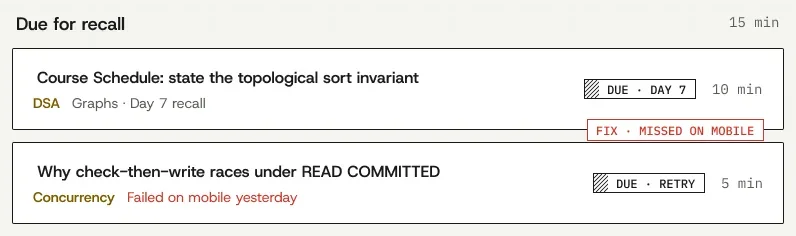
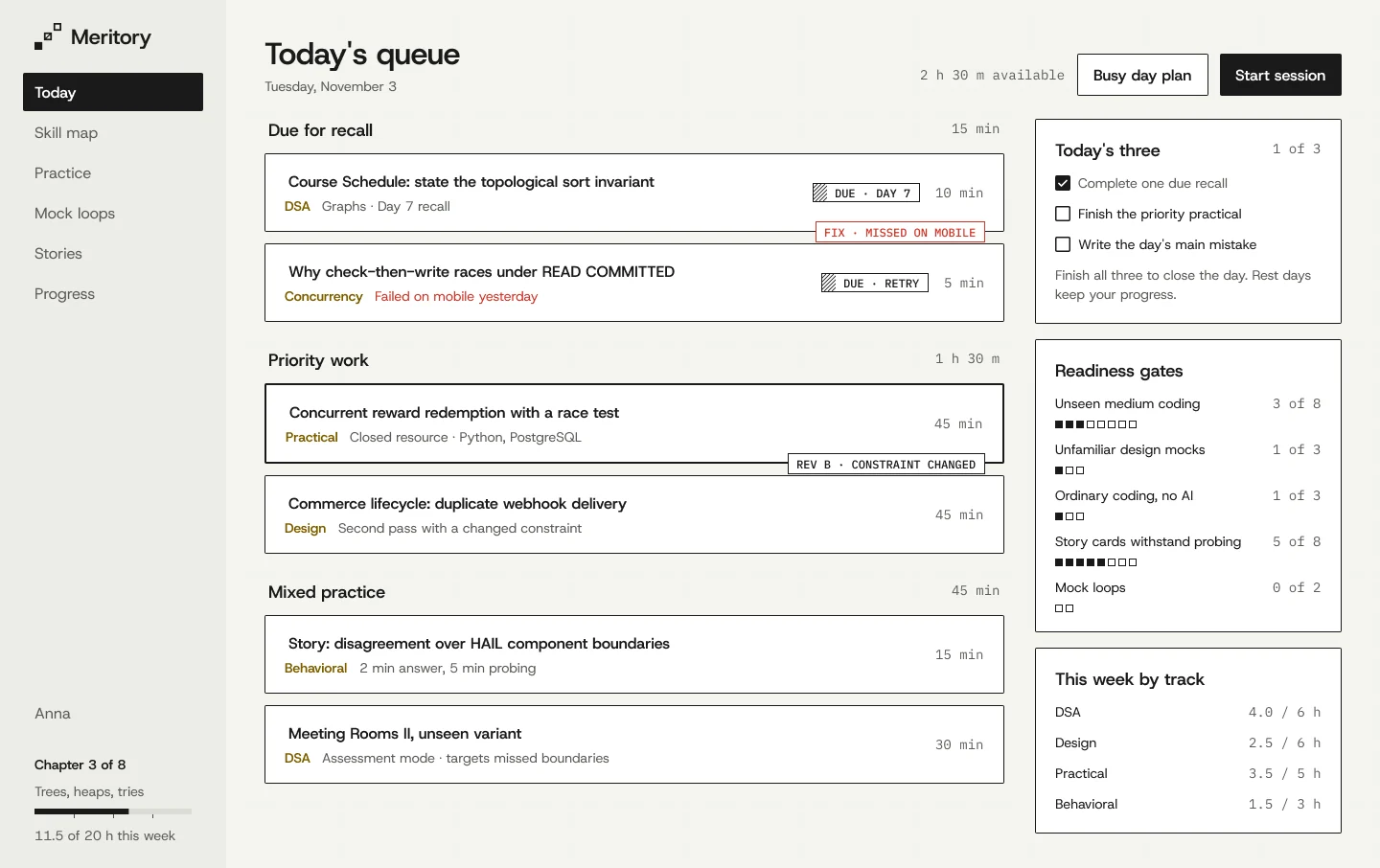
A question missed on the phone yesterday comes back here as a fresh check, tagged so you know why it's due.
- 2
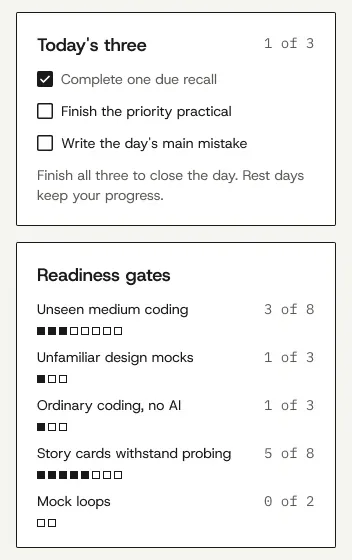
Each readiness goal is a count drawn as squares, so 3 of 8 reads at a glance.
- 3
The goal for the day is three items. Taking a rest day doesn't reset your progress.
Source: The Meritory prototype in Figma, Web / Today
The problem
Four years of TAing showed me that students learn software engineering by producing answers, not by rereading them, and most interview prep is still rereading. I want a tool that makes you produce the answer: write the code, draw the architecture, explain the trade-off. Whatever you miss on the web comes back as quick recall on your phone, then returns to the web as a fresh check until it sticks.
What I built so far
A pnpm monorepo with a Next.js web app, a Fastify API whose TypeBox schemas every client shares, an Expo phone app, and a background worker, over PostgreSQL with Drizzle. Recall is scheduled with FSRS in its own package, which never touches the database or the network, so the rules are easy to test.
The first milestone is accounts: email sign-up with verification, GitHub and Google sign-in through Better Auth, password reset, and a page to see and end your sessions.
The hard parts
Single-use email links on a library that doesn't have them.
Better Auth's verification links are stateless and stay valid for the full hour. I store a hash of each link I send and consume it on use, so a link works once, and reset tokens are stored hashed instead of in plain text.
Session control that never leaks a token.
The library's session list returns raw tokens, and its revoke call reports success for a session that isn't yours. My own endpoints return only ids, devices, and times, a stranger's session gets a 404, and ending sessions asks you to confirm it's you once your sign-in is over a day old.
Security that's tested, not reviewed by eye.
A written protocol covers escaping, SQL, redirects, and headers. Every page gets a per-request CSP nonce, a lint rule bans raw SQL, CodeQL runs on every pull request, and every input is tested against a shared list of attack strings in a real Postgres database in CI.
Where it stands
Accounts are built, tested end to end against Postgres in CI, and checked in light and dark. Next is Today, the daily practice screen, then the loop from a missed answer on the web to recall on the phone.
Built with
Next.js, Fastify with TypeBox, Expo, PostgreSQL with Drizzle, Better Auth, and ts-fsrs, in a pnpm monorepo with Biome, Vitest, and GitHub Actions.
Every screen has a design and a ticket before it has code.
Each feature starts as research and a Jira story with points, then a Figma design in light and dark with its error states. Only once the design is approved does it become code, in small commits behind a pull request.
Every merged pull request traces back to an approved design.
- 1
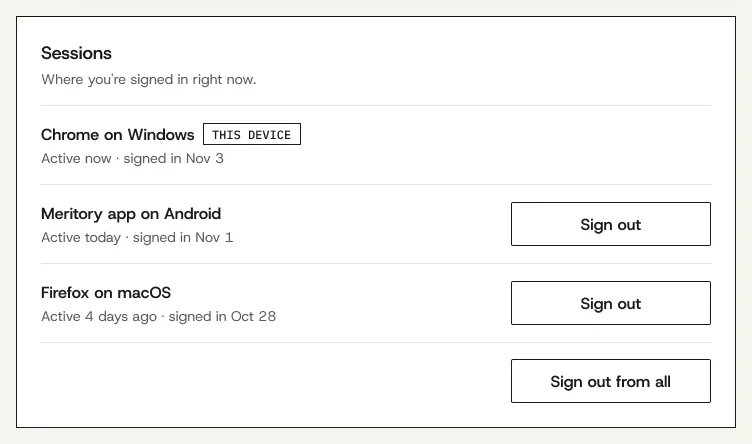
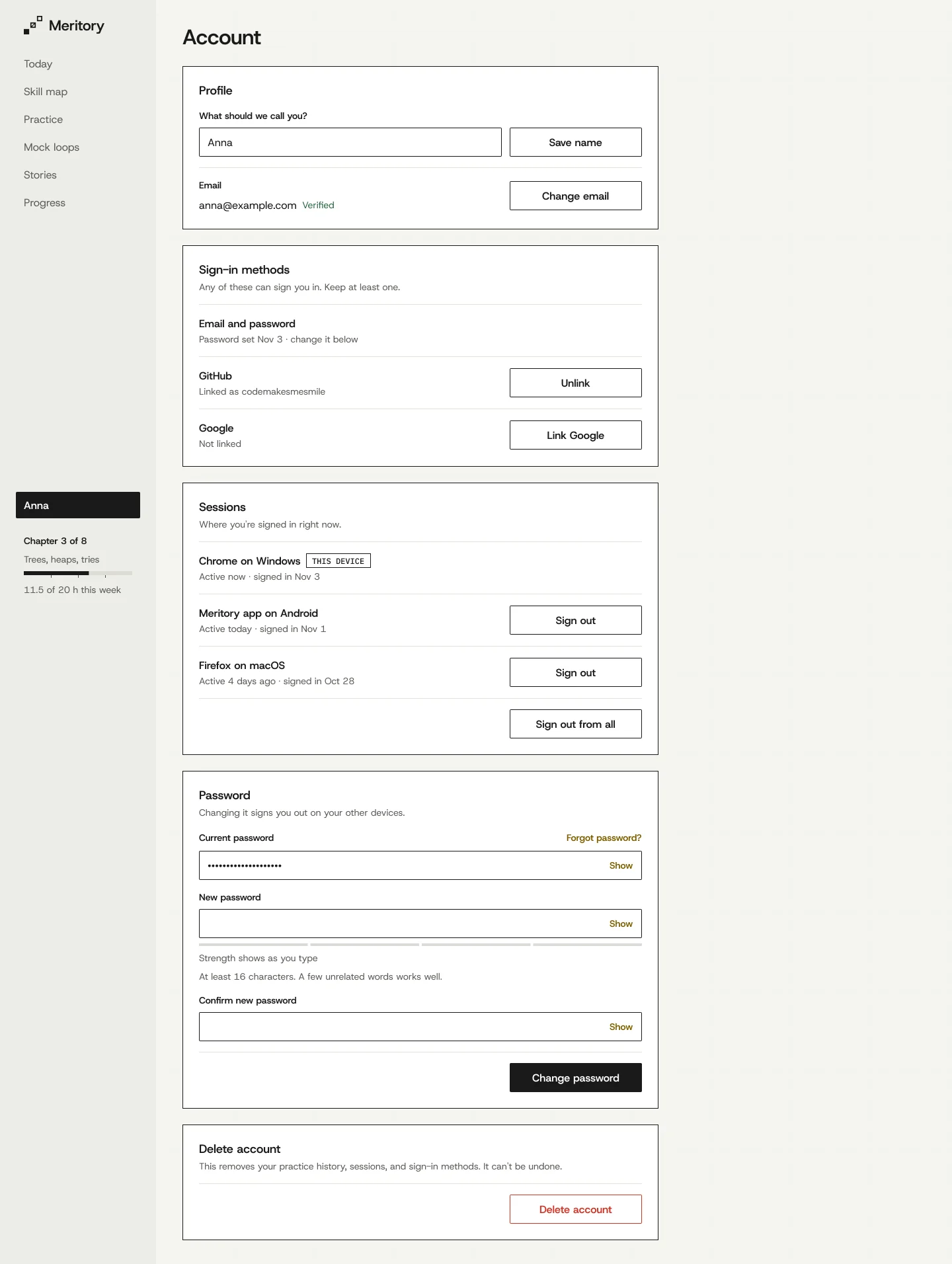
Each session shows its device, when it was last active, and when it signed in. Nothing on the page can reveal a session token.
- 2
Sign out from all ends every other session. The device you're on stays signed in.
- 3
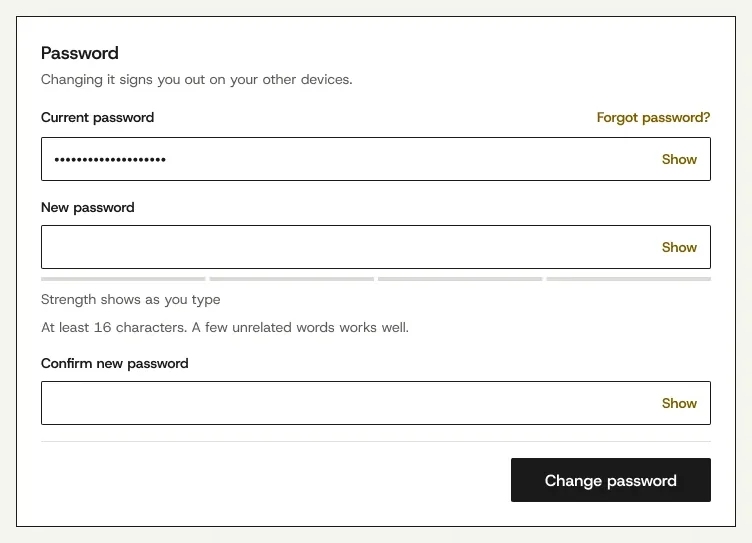
Changing the password signs you out everywhere else, and a new one needs at least 16 characters.
Source: The Meritory prototype in Figma, Web / Account
Next project
Toronto, by its trees
The map at the top of this site: 342,748 street trees from city open data, packed to six bytes each and drawn on a canvas.
Have somethingthat needs building?
If you have an idea you want built, or a project you'd like to talk through, I'd love to hear about it. I'm based in Toronto, and distance isn't a problem.